


Give Your Students The Informed SLP®
Help your students build a habit of evidence-based problem-solving with access to The Informed SLP®.
We offer graduate students free passes through their department faculty. This gives them access to our database of research reviews and clinical materials. Get your class signed up today!
How The Informed SLP® Helps Your Cohort

Hundreds of journal articles relevant to SLP practice are published monthly. Our staff of expert clinicians and scientists reads them all.
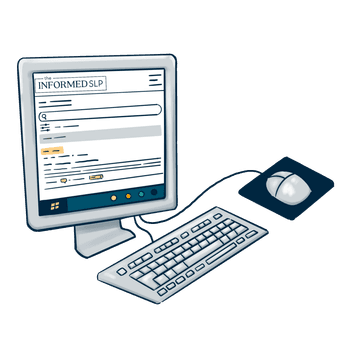
We provide the clinical takeaways in our easy-to-read research reviews. SLPs and students can read our new research reviews each month or use our database to search by topic.

Your students can use TISLP to build their research analysis skills, find evidence-based treatment strategies, and gain background knowledge for clinical placements.
Here’s how our University Program Works
Request access for your class
First, fill out our form to request free membership for your cohort of graduate students. Any faculty member can request access for their students.
Hassle-free sign up
After you’ve requested access, we’ll send you a link to give to your graduate students with easy sign-up instructions.
Students have access through graduation
After activation, students have access to The Informed SLP® through their graduation date. This means your program can incorporate our research reviews into multiple courses, including externship preparation.
Each university receives one supervising faculty token
The faculty token lasts until the end of the calendar year and must be re-requested annually. It is provided on a first-come, first-serve basis. We also offer discounted group rates for universities that wish to provide faculty with access and embed our content throughout multiple courses. To learn more, please contact groups@theinformedslp.com.
FAQs about our University Programs
Can I use the same pass for my class each semester?
Each university’s student pass activation link will expire in December every year, so faculty will need to re-complete the student pass request form each calendar year to get new students on the plan. Students’ access will last until graduation and does not need to be re-requested annually.
How do you ensure quality?
For quality assurance, we only cover peer-reviewed journal articles in journals that are indexed by PubMed. Then,
to ensure the accuracy of our reviews of this research, all our content goes through 3–5 internal staff and/or
external topic area experts.
Our writers have both a research and clinical background, which is a minimum requirement to write for us. We're
learners at heart and enthusiastic investigators! Every research review also goes through one or two editors, and
often through one of our bias auditors or our topic area experts, and then is sent to the original journal article
author pre-publication for audits. Thus, every single review on our website has been examined by at least three
people, and MOST of the time also by the original author of the research.
Learn more about our process here.
How much of the research do you cover?
As close as we can possibly get to all of it—which we estimate to be over 95% of our field’s research. While we find and read all the research out there, we only review articles that are immediately clinically applicable for SLPs. You can find the list of journals we scout on our process page.
Do you cover all topics within the SLP scope of practice?
We do!
How can all of our academic and clinical faculty get access?
We offer special discounts for university faculty groups. Find out more about our group memberships here.
Incorporate The Informed SLP® into Your Students' Learning
Consider these activities suggested by faculty members who already use our content:
Incorporate into your Research Methods course. Many universities choose to introduce TISLP to graduate students during their research methods course to support your discussion of topics like levels of evidence, critical appraisal of information, clinical application of research evidence, and strategies for integrating research consumption into their daily clinical practice.
Reinforce your own analysis. Assign a peer-reviewed journal article for students to analyze and identify the clinical application, limitations, and bias. Students can compare their analysis to a corresponding research review of the same paper. What did they miss? Do they agree with the differences in interpretation?
Go backwards. Assign students a research review to read. Then have them identify any holes in their background knowledge.
Contrast information sources. Assign students a research review to read and then think-pair-share to discuss how the information is the same or different from textbook readings. Explore how quickly science moves or the difference between information for highly specific cases versus more generalizable knowledge.
Lean on our clinical resources. Use the assessment and treatment materials we create (or the open-access materials we locate in the literature) to scaffold your student’s independence in completing mock assessment or treatment plans.
Help students get the most out of their clinical placements and externships by showing them how to:
build their background knowledge of a specific setting, diagnosis, or treatment approach by searching our database.
use our Clinical Resources and Open-Access Materials to find free, evidence-based assessment and treatment approaches.
You can reach out to us at groups@theinformedslp.com if you need more support with integrating our research reviews into your classroom.