Agency vs. direct: How SLP jobs actually work today
What agencies and ghost jobs have to do with each other, and why it matters for SLPs
In our jobs database, we divide jobs into two categories: agency vs direct. While there can be some gray area between the two, the broad categories work well to capture job features that SLPs are looking for, and help them understand how they fit into the employment picture.
What’s the difference between agency vs direct work as an SLP?
Agency
Definition:
When agency-employed, you’re working through a third party that sits between you and the facility where you provide services. The agency (contract company, travel company, therapy company— all versions of the same idea) holds the contract with the school, SNF, or hospital receiving services, and you deliver the care on their behalf. Within an agency, you may be either W2 or 1099. Ultimately, the defining feature of agency work is the middleperson— someone else owns the relationship with the facility, and you’re slotted in to do the clinical work.
Pros:
Sometimes agencies will have higher hourly rates, more flexibility, better working conditions, and better boundaries for SLPs. This is all highly variable by agency.
Cons:
Because you're not employed by the place you’re working, sometimes you won't be treated the same as your coworkers. This can impact culture and connection. You also don’t get promoted by the people at your workplace, because your true employer is the agency. The agency also takes a cut of the bill rate and there’s typically less job security (except for with the really good agencies that employers love; those contracts can remain active for many years). You also may sign yourself out of being able to be hired direct.
TISLP Staff Opinion:
The simplest way to think about this is that agencies are simply a middleman between you and the place you work, and that can come with pros and/or cons. For example, sometimes agencies are great for the SLP because they take over battling systems (schools, hospitals) that are really hard to budge. When the agency cares a lot about their SLPs, the best agencies can be better than direct work, because they have the freedom to build the types of jobs that SLPs want. But again: Agencies are simply middlemen. So in the worst cases, agencies feel more like a layer of commodification of SLPs rather than support. Knowing which "type" of agency you're going to get is tricky, and requires you to lean on what other SLPs say about them, and learn how to judge contracts. We help you with as much of this as possible with our SLP Career Resources, and by asking agencies the questions you should be asking and putting that information in our job posts. Finally, our vetting system means the agencies really mistreating SLPs simply won't be on our jobs board because we've blocked them. Here are the companies and agencies we’ve accepted jobs from. At minimum, they’ve passed our pay, productivity, and transparency requirements. The ones not on that list are either blocked from our database, or have never tried hiring via Informed Jobs.
Direct
Definition:
You’re hired by the facility itself— the school district, hospital system, SNF, clinic, or private practice owner is your employer. No middleman. You’re on their payroll, you go through their HR, you’re part of their org chart.
Pros:
More stable, typically better benefits (especially in the schools and large hospital systems), clearer path for advancement, more integrated into the team and clinical culture, easier to build long-term relationships with patients/students/families.
Cons:
Can be lower hourly pay than agency work (this is highly variable), with less flexibility, more bureaucracy, and harder to leave or switch settings. The best way for you to judge an agency vs direct contract is to our understand how contracts work in the first place.
FAQ: “Is agency vs. direct different than W-2 vs. 1099?”
Yes! These are two separate things. Agency vs. direct describes who you work for. Agencies act as middlemen between you and the facility, while direct work means you're employed by the facility itself. This distinction tells you a lot about your relationship to the workplace, how your contract is structured, and how negotiations tend to go.
W-2 vs. 1099 is a separate question about your tax and employment classification—essentially, whether you're treated as an employee (W-2) or as self-employed (1099). The W-2 vs. 1099 distinction determines your tax and benefits situation.
The confusion arises because both factors shape your contract—but they're independent variables. All four combinations exist: Agency W-2, Agency 1099, Direct W-2, and Direct 1099. Direct hires are almost always W-2, but there are edge cases—some facilities, especially small private practices or early intervention providers, bring SLPs on as 1099 contractors directly.
(HOT TIP: Are you a 1099 contractor but didn't realize that means you're self-employed? Time to figure that out.)
FAQ: “Which is better, working direct or through an agency?”
There isn't an answer to this! As we said above, some of the best jobs in our database are from agencies, and some of the worst jobs we've ever seen are from agencies. Same with direct. It’s not a better vs. worse thing. Instead, we want you to understand that the widespread use of agencies is a newer feature of the SLP field, and it's created situations and circumstances that most SLPs don't understand. And an informed SLP must understand all of this in order to get what they want out of their next SLP job, so keep reading! Here's a Facebook thread with feedback from real SLPs on what they prefer.
How it works: The financial difference between agency and direct
First, agencies are increasingly common in our because SLPs are hard to hire. That situation has made it reasonable for agencies to charge a fair amount for all the work and expense it takes to find and place an SLP.
How the markup works
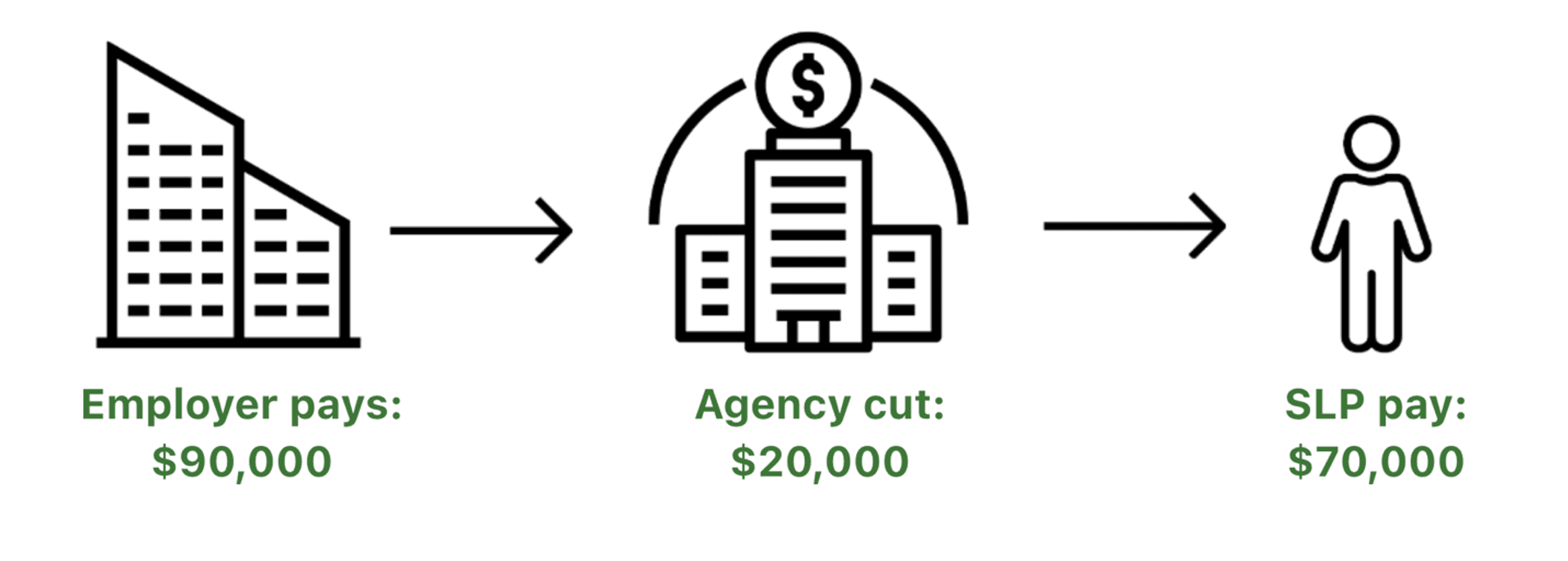
When a facility hires an SLP through an agency, they pay the agency roughly 15–30% of the SLP’s first-year salary as a one-time fee. When a facility instead staffs the role through an ongoing agency contract, they pay the equivalent of roughly 30–60% of the SLP’s annual pay in agency premium every year, for as long as the contract is renewed. This is in the form of a markup on the bill rate, and is also why agency jobs are typically listed as “hourly” not salaried. Agencies vary widely in terms of how much they take off the top, but here’s a super-simplified diagram to demonstrate:
Why this cut makes sense
Agencies carry real costs and risks the facility offloads, including recruiting, credentialing, payroll, liability insurance, unemployment exposure, and the financial hit when a contract ends or a clinician quits mid-assignment. Their cut reflects what it takes to absorb all that.
Employers are also willing to pay this premium because the alternative isn’t always “hire direct for less”, but to leave the position unfilled, which means lost revenue, compliance violations, and clients going without services entirely. When SLPs are hard to hire, it can make sense to pay to find one.
FAQ: “Can I be my own “agency” and just take the cut from the middle?”
You sure can! We highly recommend Therapist Support Network to teach you how, and to help you understand that contracting is not only for large agencies — you can be your own agency. Here’s their blog, so you can get informed on what this looks like before taking any leaps or plunges. TISLP Staff Opinion: Contracting directly with the schools is not easy to pull off. But well worth it if you're willing to put in the time and effort to learn and make it happen!
FAQ: “How can I find out what an agency is charging my school district?”
We'll write a longer article on this and come back later to link it. But the short version is this:
Public school districts spend taxpayer money, so their contracts with outside agencies are almost always public record under your state’s open-records law. Often the information is findable online with some savvy sleuthing, including checking the school board’s meeting agendas and minutes, the district budget, or vendor payment registers. A few tips:
- Be specific. Name the vendor’s exact legal name and the contract period. The right results tend to pop up faster with the agency name.
- Find the contract number. Search a government-contract aggregator (Google “highergov.com [agency] [vendor] contract”). It’ll show the number, but you don’t need to pay the site; you only need the number, then search again using that.
- Find the right office, and make a request. Identify district, county, or state, then request the contract contract, its rate schedule, and any amendments. Ask for the rate structure specifically, not just “what they're charging” which can be misleading.
How it works: hiring and placement logistics
This part is near and dear to our hearts. It's one of the motivations behind creating an SLP jobs database—one that gently pushes employers and agencies to disclose what's really happening in the hiring process. So much of it stays hidden from view, but has a real impact on SLPs.
What SLPs think happens
Here’s the mental model most SLPs are working from when they apply for a job: a facility has an opening, the agency agrees to help fill it, the agency posts the job, the SLP applies, the agency and facility review the application and conduct interviews, and offer is made, and you have a job! A job opening, a jobs post, a hire. Clean.
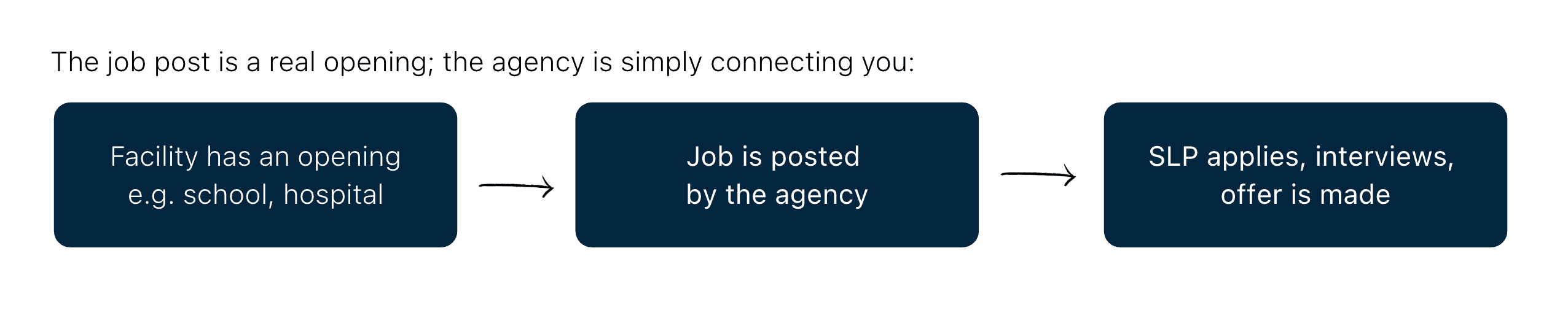
Now, a lot of times this IS exactly what's happening! Especially with smaller agencies, and especially with jobs in our database. But often, with larger agencies that can manage many moving pieces, what happens instead is more like this...
What actually happens
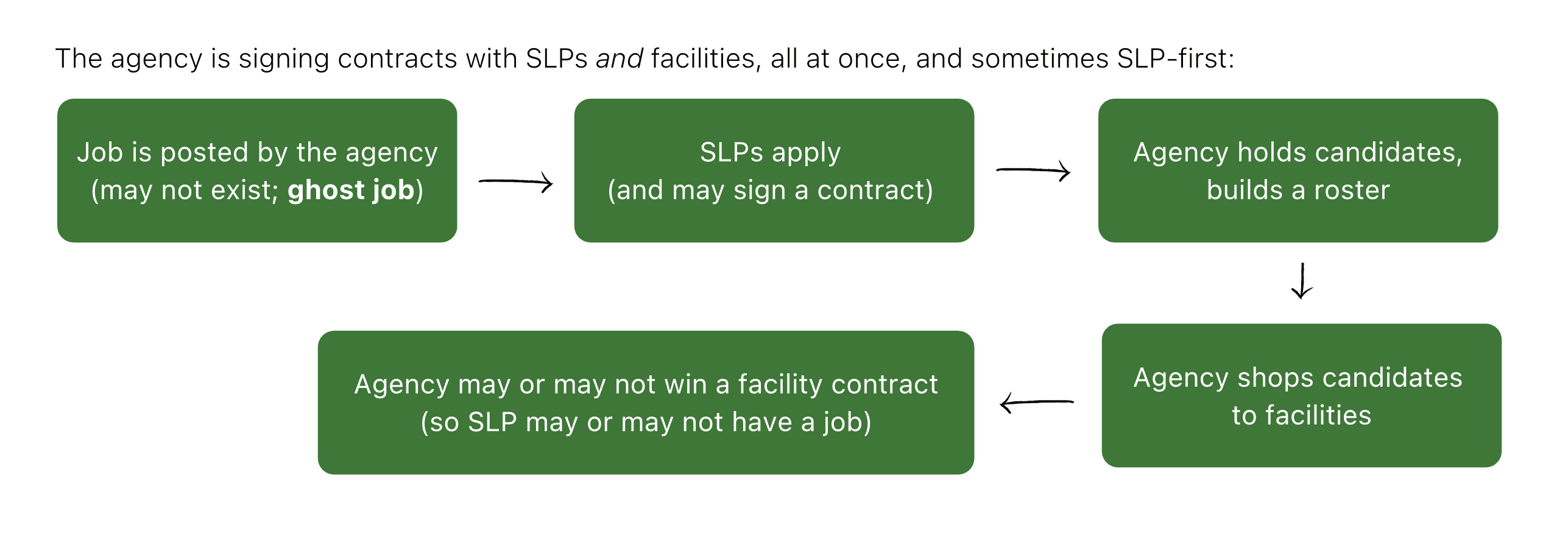
Notice how in this second model, SLPs are signing contracts with agencies before there’s an actual job available for them.
Hold on, read that one more time! SLPs are signing contracts with agencies before there’s an actual job available for them.
Now, this isn’t necessarily a “bad” thing because agencies often can place SLPs, pretty easily and successfully, and when the agencies have SLPs already signed on and ready to work, this keeps that whole process moving. The issue here is consent: Do SLPs know it's not a real job opening yet? Do they know the difference between signing with the agency vs applying directly on the school district website? Do they know what they're getting, or may be signing away? Might unknowing SLPs sign a contract with an agency, thinking there's a job in a city and setting they'd like to work in, sign an apartment lease and move to a city without an actual job, only an agency contract, and end up with no job? (Yes, this happens. Regularly.)
We don't want to say it's "wrong" to sign an SLP first, then shop them around. We understand why this has to happen sometimes. However, we believe in transparency. We believe that SLPs have a right to know from the job post itself whether or not there's an actual opening behind that post, so they can decide if they're ok with applying, and know the small risk they're taking in doing so. Otherwise, SLPs on job boards are simply self-perpetuating lead gen factories, sending resumes everywhere, texting with recruiters, getting on a million phone and Zoom calls, applying to jobs that don't exist, competing with themselves across multiple agencies, and giving away every ounce of their power. This is what ghost jobs cause. And we believe that ghost jobs are one of those “lying by omission” type things, where agencies know SLPs can't tell the difference and are taking advantage of that fact. We correct for this by banning ghost jobs and requiring the location to be disclosed in all job posts in our database.
FAQ: “Why would agencies post all these ghost jobs? Why lie?”
In the recruiting space it's not seen as lying; it's seen as necessary. Potato–potahto.
And ghost jobs aren't just coming from agencies, nor just in speech–language pathology. Ghost jobs are everywhere, in all fields, for many reasons, representing 20% of jobs on traditional job boards.
Agencies are simply much more likely to use ghost jobs as a strategy, but the core reason (in SLP) is because employers are competing for visibility. Agencies need that visibility most, because the one thing they're promising is to be able to fill positions. In fact, agencies need to overshadow the very people (school districts, hospitals) they're being paid by to help (now isn't that funny little a conundrum...)
So when visibility is the name of the game, it's MUCH better for an employer or agency (who can afford it) to posts jobs in every single city and setting that exists, regardless of if those jobs are real. Agencies are incentivized to keep a deep bench of candidates ready to go. When a facility calls with an urgent need, the agency that can submit three credentialed SLPs today wins the contract over the agency that has to start recruiting from scratch. This is what causes agencies to post listings that read like real, specific jobs (“Full-time SLP, pediatric outpatient, [City]”) but are actually pipeline-building.
Ultimately, ghost job posts normalize opacity in job posts— which is the exact opposite of what SLPs need in order to choose good jobs for themselves, and the exact opposite of what we’re trying to do in our jobs database. So we don't let that happen here.
FAQ: "How can I avoid SLP ghost jobs when I'm looking in other places, like Google or Indeed?"
If you’re searching for jobs on our platform, all of this is a non-issue because we’ve asked all this for you already. We don't allow ghost jobs on our platform. But if you’re searching elsewhere, here are a few questions to ask:
- “Is this an active opening with a confirmed start date, or are you building a candidate pool?”
- "Is your agency the only one working this position, or is the facility using multiple partners?”
- “Can you tell me the name of the facility before I commit to being submitted?” (Reputable agencies will share this once you’ve expressed real interest; ones that won’t are often shopping listings they don’t actually own.)
The goal of the database we’re building is to make these questions unnecessary — to tag listings with what kind of opportunity they actually are, and require enough job details (like location) that naturally block ghost jobs, so SLPs can make informed decisions about where to spend their time.
FAQ: “Why are there so many more agencies than there used to be?”
Right?! Look at ASHA Corporate sponsors. Look at jobs boards (not ours, but traditional ones like Indeed or our competitors, like SpeechPathology.com). Agencies are everywhere and work VERY HARD to get in front of SLPs. It's literally their job to do so! But that wasn’t the case for those of us who entered the job market in the 90s, 2000s, and 2010s. So what changed? Many things, including:
SLPs are hard to hire. The shortage is real, and (probably) getting worse. The U.S. Bureau of Labor Statistics projects that SLP employment will grow 15% from 2024 to 2034 — much faster than the 3% average for all occupations — adding about 28,200 new SLP jobs over the decade. When a facility can't fill a role with a direct hire, an agency is often the only way to keep services running.
COVID permanently changed what SLPs want from work. Many SLPs left traditional roles during and after the pandemic and aren't coming back to the old model. They want flexibility, remote/teletherapy options, and the ability to switch settings without a big life upheaval, and shorter commitments. Agencies are built to offer exactly those things.
Teletherapy lowered the barrier to starting an agency. When SLPs had to physically show up at a building, an agency needed local infrastructure, local recruiters, and local relationships. Now a recruiter with a laptop, a credentialing checklist, and a few facility contacts can run a virtual staffing operation that places SLPs across state lines (which will get even easier with the Interstate Compact). Agencies have simply become easier to run.
Healthcare staffing is a large and growing market. We're seeing new agencies founded regularly, and existing ones getting acquired and rolled up under bigger parent platforms that can often do the job even more effectively due to scale. Part of what can look like "more agencies" is also just more brand names.
The rise of ghost jobs on traditional job boards (e.g. Indeed, LinkedIn) both bolster and artifically inflate the visible number of agency jobs. When you search on these platforms, it looks like "everything" is through an agency. That's because they allow ghost jobs. An agency can have NO open jobs (in theory) but put a job post in every single city and setting that exists, if they're large enough to be able to afford to pay for that. Alternatively, on our job board the blocking of ghost jobs removes this; and you'll notice that more like 70% of our jobs are direct. What can look like only agency jobs exist in a city is never true. Use our jobs board or visit school or hospital websites directly and you'll find lots and lots of direct jobs for SLPs.
Finally, we've said it before but have to keep saying it: the agency model, done well, can be a great thing when it gives SLPs leverage, options, and pay that traditional employers couldn't offer on their own (e.g. due to salary schedule limitations). The problem is that growth this fast has outpaced accountability, and SLPs are generally under-informed on this topic. That’s what we’re here to do—make sure you know your options, and choose right for yourself.
FAQ: “Where can I find a good SLP recruiter?”
We're only inserting this question here because we see it all the time. But if you've already read this whole article, you probably won't be asking this question. Nonetheless, here's the answer:
A recruiter is simply a salesperson for an agency. A recruiter can: guide you through the process of being hired at an agency. They can not: guide you through all job opportunities in your interest area, the way a real estate agent could take you to any house you ask for, or a hair dresser could give you any haircut you ask for (in theory). So asking for a “good recruiter” is not = asking for a “good job” unless you’re already 100% sold on working for a specific agency, and you just need a person to talk to there. But when that's the case, it's not hard at all to contact the company. They'll be tripping over themselves if you show up at their doorstep asking for a job. Which is why it's usually a signal to us that a person doesn't understand what an agency is if they're on the internet asking "Where can I find a good recruiter?"
All good with understanding agency vs direct work as an SLP?
If not, please email us if there’s parts of this that are still just confusing, or topics you want us to address! Our job is to create Informed SLPs on the job market.