Why there's (almost) no such thing as an hourly rate in the SLP field
Most SLP jobs that say "hourly" are actually variable, so examining contract details is crucial.
What do you mean there's no such thing as hourly?! That's how all of us talk about our jobs.
We know. And it's excruciating, because it has each of the following negative impacts on SLPs:
- It makes it impossible for SLPs to talk about pay with each other when we lead with "hourly". When SLPs talk about pay we're mixing true hourly rates with e.g. visit rates, constantly comparing apples to oranges (to pears...), and not actually talking about true pay.
- When we feed these non-hourly "hourly" rates into wage data sources, it makes the data itself useless because non-SLPs don't understand SLP contracts well and correct for this accurately.
- It makes it harder for us to negotiate our true pay up, when we don't understand how "hourly" rates really play out within different contract types.
- These non-hourly "hourly" rates are also how we a) regularly end up on "Top Paying Jobs" lists, year after year, and b) how local, state, and national policies end up shifting our pay down instead of up because they too don't understand our pay and can't find good data on it.
We're not exaggerating when we say that the focus on hourly rate for SLPs has really screwed us over and will continue to until SLPs switch to talking about our pay in annual terms again. No hourly without annual, friends!
Why all these hourly rates we discuss "aren't hourly".
Employers rarely pay SLPs the same rate for all hours worked. When they do, they typically just switch you to a salaried contract. That means most jobs that lead with "hourly" aren't hourly at all. They're variable, or e.g. visit rates.
➡️ Here's why that matters:
While all our hourly rates in our database are real because we've calculated them out (with employers) based on true payroll, most other jobs databases are displaying visit rates only. Visit rates aren't hourly rates. And because they're not actually hourly rates, they don't tell you what you'll be paid. And when you try to use these visit rates to predict pay, you'll make a lot of errors, because a "$55/hr" job could actually pay tens of thousands of dollars less than a "$40/hr" job. Seriously.
➡️ Here's how you should think about it instead:
Never expect a published hourly rate to be accurate unless annual pay esimates are right next to it. Instead, assume these numbers are just vanity metrics. Instead, "hourly" (variable) contracts pay you more on a spectrum. Think of this as a spectrum of how much you're paid for your hours worked. SLPs tend to oversimplify this and think, "Oh, I just need to ask if they pay for indirect time or not." But contracts are so much more complicated than that. All these ways of paying SLPs are quite normal:
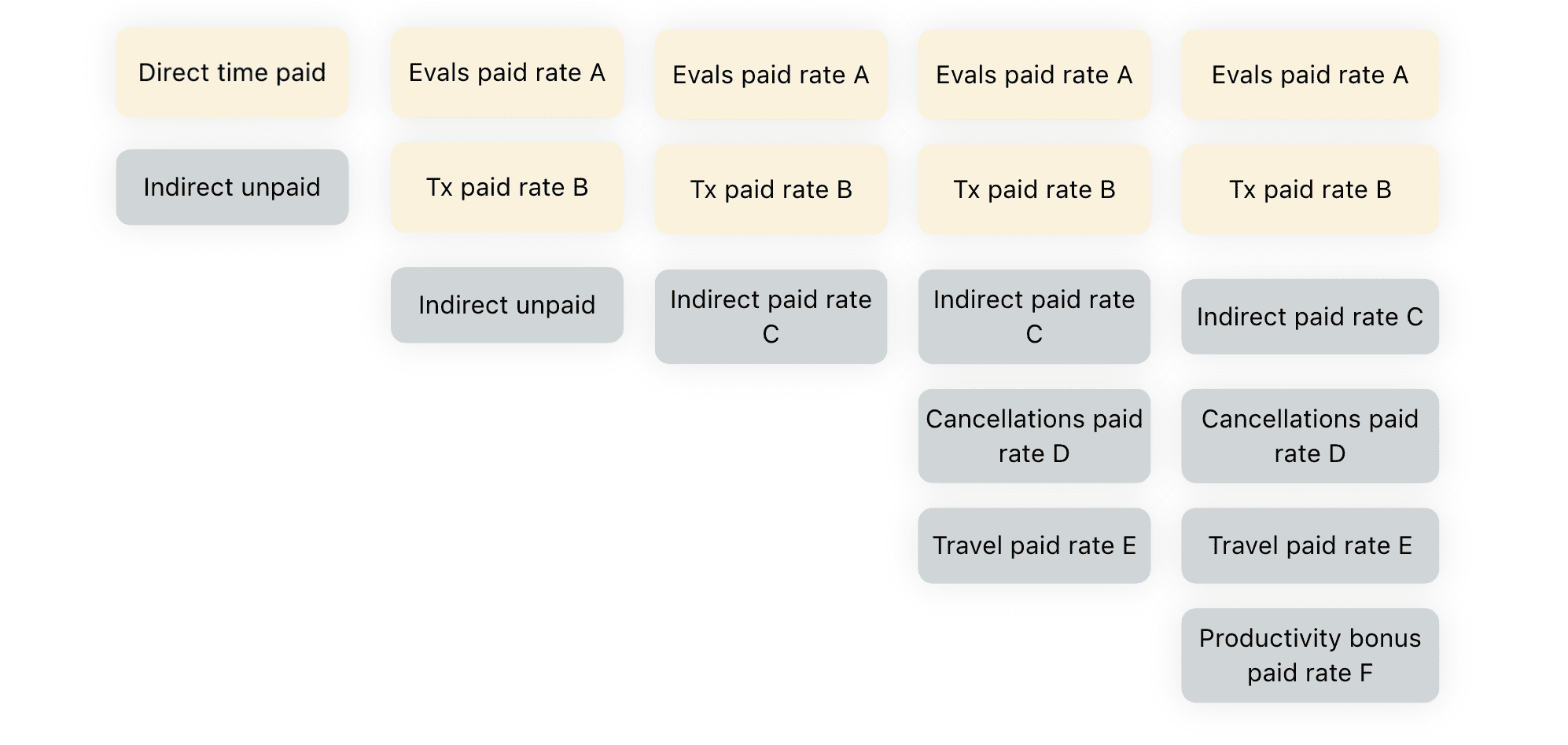
... and this is still an oversimplification because this represents 5 contracts types but there are truly infinite ways employers are paying SLPs these days. And do you see how the more SLP work is subdivided into categories of how we could be paid, and further subdivided into various rates, how difficult that makes it for you to predict your pay? That's why we're telling you to never accept these jobs without an annual estimate.
Ultimately, we have far fewer salaried jobs than we did 20 years ago, far more variable and pay per visit (PPV) jobs, and very few truly hourly jobs. Times are changing, and it's in our best interest to keep up!
What is direct time, indirect time, and pay-per-visit (PPV)?
If you're a seasoned SLP, you may not need to read further. If you "get it" now, carry on! Otherwise, stick with us:
- Direct means the time you're directly with clients, face-to-face. This includes treatment and evaluation time. Pay per visit contracts are paying you for direct time only.
- Indirect is all the other work you're expected to do that doesn't involve clients being present. This typically includes writing IEPs, evaluation reports, and progress notes; lesson planning and preparing materials; consulting with teachers, parents, or other professionals; attending IEP meetings; data analysis; documentation and billing paperwork; and travel between schools or sites.
With pay per visit (PPV) or direct time only, you're only paid when working directly with clients. Unlike salaried positions, your hours and pay aren't guaranteed. They're variable based on somebody else filling your caseload and clients not cancelling too much.
➡️ Want data? Of all the jobs that come into our database listing an "hourly" rate, <30% of them are actually hourly. All the rest are variable, or closer to a PPV contract. Which means that for 70–80% of jobs (that aren't salaried), you need to consider all this information. Keep reading!
Why can’t you predict pay from visit rates? Can't I just ask a few questions and get a good estimate?
The more questions you ask, the close you'll get. But it's much easier on you and the employer to just request an accurate annual estimate. Otherwise, here are all the things you'll need to account for, and ask about:
(These are also all the reasons SLPs shouldn't talk about pay in "hourly" terms without annual.)
Pay per task type:
- Some clinics pay direct time only (client treatment/assessment) – no pay for paperwork/admin
- Some pay for certain indirect work (reports) but not others (emails, calls, scheduling)
- Some claim to pay indirect time but cap it (e.g., 5 min/session or 2.5 hours/week)
- Some, while capping indirect time have policies and operations to make this realistic; others do not
- Some clinics have one rate for indirect and one rate for direct time...
... while others have multiple rates for everything. Example:
- $40/30-min session; $55/45-min; $65/hour
- $80 for evals
- $20 for documentation
- $15 for no-shows; $0 with 24hr notice
- $10 for other admin
This should make it clear already why you can't calculate actual pay from these rates. But there's more!
Session duration and travel time:
- Visit rate means nothing if you don't know the session duration. And clinics vary: all 45-min sessions vs. mixed durations (30/45/60 min) vs all 60 minute sessions, etc.
- Some pay differently per duration of the session; some pay the same rate (e.g. $50) regardless of session duration
- Some clinics stack clients back-to-back really well; others leave unpaid gaps due to scheduling, travel, cancellations, or heavier indirect expectations
- Some clinics have you travelling; others don't
- Some clinics pay your full hourly rate for travel; some only reimburse mileage; some do both
Cancellation policies:
- Some pay for cancellations; others don't
- Some have mixed cancellation policies with partial payment or varying notice periods (24-48 hours)
- Cancellation norms vary from <5% of clients cancelling regularly to 30–40% of your caseload cancelling every single week. So it's not just about are you paid for cancellations, but how often this client base tends to cancel.
Indirect work expectations:
- It's not just about paid vs unpaid – it's how much indirect work. Because:
- Some encourage point-of-care documentation; others demand lengthy reports
- Admin duties vary (scheduling your own clients, cleaning, meeting with families) – sometimes 20%+ of your week
Other complications:
- We've seen employers do things like PPV in the first three months of employment, then you’re switched to salary after that.
- We've seen employers provide productivity bonuses on top of your session rate, which additionally makes the math very complicated. Especially when "great" at some clinics is anything over 70% productivity, and "great" at others requires > 90% productivity. You can ask what percentage of their SLPs tend to get the productivity bonus to start to get at how realistic it is for you to get one.
Bottom line: Do you see now why reading an hourly rate in a job post is meaningless? Do you see now why telling other SLPs your visit rate when discussing pay is meaningless?
Solution: Always request and discuss annual along with hourly.
How is pay displayed at Informed Jobs?
In our jobs database, our pay rates can be trusted because we're asking all the right questions (as above) AND requesting annual estimates based on payroll data AND running the appropriate math for you. Each job will have pay displayed right under the title.
- The first number in dark navy is what the contract states.
- Then the other numbers, in light gray are hourly or annual estimates, based on the questions we're asking employers.
- The third metric listed (Informed Pay) allows you to directly compare 1099 and W2 jobs. Read more on Informed Pay here.
This means all jobs will be listed as either hourly-first or annual-first, like this, depending on the contract:


... and we never have a job post that doesn't have all three numbers, verified for accuracy.
But you're probably thinking, "You said most jobs aren't hourly though?" So why do I see hourly pay listed first like that? Precisely. And you infrequently will. Instead, many jobs in our database that aren't salaried end up looking like this:

See how there is no dark navy rate? That's a variable contract. We're asking all the right questions to get good (true) hourly and annual esimates for you, but these are ultimately contracts in which pay isn't guaranteed, so you have to be ok with that range and variability.
How can I predict my pay from PPV job posts on other websites?
The bad way: Trying to ask 30-trillion questions to get an accurate number. When we first launched our jobs database, we THOUGHT we could do that, too. Surprisingly, it's not as accurate as just asking one question.
The best way: We call this the "magic question" because it overrides everything else. Ask the employer:
"What is the average and range of annual pay for SLPs who currently hold this position full-time at your company?"
And that’s it! Because asking that will immediately show you not only the true range of pay you can expect, but is a spot-check of employer transparency as well. ALL employers know these numbers. And all SLPs have the right to know these numbers when they're trying to choose a job!
TIP: Don't let them try to tell you what you could make. Ask what you will make based on their current SLPs' payroll data.
Exception: In very-small companies, an employer may not have those numbers, e.g. if you're their first hire. If so, you can guesstimate by multiplying the visit rate by .7. So if they tell you it's $60/visit for hour-long visits, you can assume you'll be making $42/hr. This "70% of the hourly rate" calculation is based on our own internal data on how most contracts tend to play out. On average, 30% of working hours will be unpaid due to cancellations, indirect time, travel time, etc.