How to avoid inaccurate wage data for SLPs
Most SLP pay norms are wildly inaccurate. We’ll show you which data sources to use, which to avoid, and how to interpret them.
Most readily-found sources of speech–language pathologists' (SLPs) wage norms are inaccurate and unreliable.
- In the following article (below) we focus on why most wage norms you'll find for SLPs online are wrong.
In our other article (here) we focus on what you can use instead!
Both matter, because you need to understand what NOT to do as much as you understand what TO do. Understanding this topic deeply will also help illuminate a lot of the problems we're having in our field. So read on!
As of 2026, most SLPs still have no idea where to find reliable pay data. That's primarily because sources that should be trustworthy (like the Bureau of Labor Statistics) aren't, because SLP contracts are highly complicated and they don't account for that. And sources we might be willing to trust because they're large (e.g. Indeed) are even worse than the BLS, due to further screwing up wage calculations. And even our fellow SLPs reporting into datasets like this one, or threads you'll see on Facebook and Reddit are also wrong because we haven't internalized the true financial impact of our contracts on pay a whole lot better than anyone else has. That's right— it's us messing up our own wage data too.
That's right, we're saying it: We're all operating on "close enough" numbers that are actually tens of thousands of dollars, sometimes $50,000+ off due to a lack of accurate wage data available AND us not understanding why it's inaccurate.
Are you ready to be someone who doesn't make these mistakes? We'll explain the "why" below!
How is SLP wage data SO wrong in most sources?!
The primary reason for this is that SLP contracts are uniquely structured, and highly variable. This means that datasets and resources (e.g. the BLS) that can be fairly reliably used by other professions (engineers, teachers, etc.) cannot be used by SLPs. But as of 2026, our field hasn't quite caught on.
Let's start with the 2080 rule:
First, you have to understand that almost all these data souces collect pay as either hourly or annual, then use the number 2080 to convert between these. So all hourly data dumped in is multiplied by 2080 to find annual; all annual data is divided by 2080 to find hourly. This is normal for jobs databases, HR departments, everywhere. This "2080 Rule" applied to SLP contracts, however, doesn't work. It winds up being a math error that literally every SLP wage data set we've ever seen online except ASHA's and ours makes.
Why 2080? This represents the total work hours in a year for someone working full-time (40 hours per week × 52 weeks = 2080 hours).
Why the issue? The issue is, this calculation assumes that everyone in the dataset who's working full-time is paid for 40 hours every week for the entire year, which isn't accurate for SLPs.
- Approximately 60% of SLPs are on 9 month contracts (school-based SLPs)
- Approximately 30% of SLPs us are on variable hourly contracts, and you can't multiply these contract rates (e.g. visit rates) by 2080 and get an accurate number of paid hours per year.
Only those who are salaried contracts for 12 months out of the year does the 2080 calculation apply to, which is a very small group of SLPs.
OK. So what?
It's hard to emphasize just how much this can screw up a dataset, unless you start running the numbers yourself. So we'll create a pretend dataset to help it make sense! Here are 10 SLPs' wages. For simplicity's sake, let's assume they all live in Kansas City, and they all work full-time. Here is their name, setting, and contract rate:
| Sarah | Elementary School | $65,000 per year |
| Susan | Early Intervention | $55,000 per year |
| John | Hospital | $70,000 per year |
| Daphne | Hospital, PRN | $80 per hour |
| Joey | High School | $72,000 per year |
| Maya | Private Practice | $58 per hour |
| Jordan | Private Practice | $55 per hour |
| Taylor | Early Intervention | $50 per hour |
| Madison | SNF | $60 per hour |
| Stephanie | Acute Care | $78,000 per year |
With a quick glance, you can see that annual wages are $55,000 to $78,000. Then "hourly" rates are $50–$60 per hour, with one outlier at $75 per hour. All of these numbers makes sense, and are accurate and normal Kansas City. But they make sense *to us as SLPS* because we know our contracts. While we're not used to running math on them (but should be...) we at least are familiar with what they look like on job posts and when we sign a contracted rate. And they do look just like this!
But others don't know our contracts. So when they get ahold of "hourly" (not actually hourly...) and annual data like this, they start multiplying and dividing those numbers by 2080. They don't realize that $50/hour for us doesn't mean we're paid $50 for 40 hours in a week. It's often direct time only. And those school contracts? Those are 9 months. Hardly any of our contracts pay us for 40 hours per week, 12 months out of the year, for 2080 total hours. But the 2080 rule gets applied anyway. To everything. All the annual rates are divided by 2080. All the hourly rates are multiplied by 2080. That makes the averages for this dataset, above:
Average annual wage = $97,000 per year
Average hourly rate = $47 per hour
That doesn't make any sense, now does it? Look carefully at the actual dataset. Look at what people are paid per year. Nobody in this dataset is paid > $95,000 per year, but somehow this is the average?! And the hourly rate, how does that look? Looks actually kind of correct, yeah? This is how these errors float right over SLPs' heads. Because every so often these wrong datasets will look and feel right-ish, so we assume the whole dataset is right because not ALL the numbers look wrong. But that $47 per hour average is obtained like this:
| 65,000 | divided by 2080 | = $31 per hour |
| 55,000 | divided by 2080 | = $26 per hour |
| 70,000 | divided by 2080 | = $34 per hour |
| 80 per visit | (no math) | = $80 per hour |
| 72,000 | divided by 2080 | = $35 per hour |
| 58 per visit | (no math) | = $58 per hour |
| 55 per visit | (no math) | = $55 per hour |
| 50 per hour | (no math) | = $50 per hour |
| 60 per visit | (no math) | = $60 per hour |
| 78,000 | divided by 2080 | = $38 per hour |
Do you see all the errors here? Annual salary for 9 month contracts divided by 2080... visit rates converted to hourly rates but 2080 assumes you're paid for 40 visits per week... true hourly rates treated the same as visit rates. The numbers are all too high, too low, right on, and every so often result in something that seems "close enough".
It's not close enough. Go Google SLP wages (or ChatGPT or Claude or whatever you want to use...) and you'll see how we end up on lists as one of the highest paid professions. And how that very data (e.g. from the BLS) can be used to justify underpaying SLPs or paying them less. We have barely noticed how wrong our own wage data is, as a field. Do you think policy makers have noticed? Or care?
IMPORTANT NOTE: This is also why SLPs should never talk about their wages as "hourly" alone. Because they almost never are hourly. You can't compare apples to astronauts, but here we are doing it with each other all the time when we discuss wages...
The most commonly-used SLP wage data:
There is limited reliable data available on SLP wages. Nonetheless, the three most commonly used and largest datasets available are:
- ASHA’s Annual Salary Survey
- The Bureau of Labor Statistics: Occupational Employment and Wage Statistics (OEWS) data
- Jobs board data (e.g. Indeed, Glassdoor)
Let’s take a look at each.
Resource #1 (Best, but not enough people use it): ASHA’s Annual Salary Surveys
Data collected:
Survey data was collected from 2,691 school-based SLPs in 2022 and 1677 healthcare SLPs in 2023. It is repeated biannually, so regularly up to date.
- Strengths: This is by far the most accurate data source we’ve found because ASHA correctly accounts for the SLP contract details that most other data sources mess up.
- Weaknesses: Raw data are not published, meaning you can’t calculate anything other than what they’ve already calculated for their report. The numbers are also too small to do anything really meaningful with the data, nationwide. In sum, it'd be better if it were larger and didn't do things like collapse by state.
Resource #2 (Mediocre-to-Useless): Bureau of Labor Statistics Occupational Employment and Wage Statistics (OEWS) survey
Data collected:
People tend to mistakenly think the BLS is a survey similar to ASHA’s, where people are outright asked about their wages in a certain year. However, that's not how the BLS data works. Instead, this data comes from state unemployment insurance (UI) files over a three-year period. For example, the data labeled "2024" was sampled through May 2023 and includes data as old as 2020 averaged into it, so it’s a more out-of-date than ASHA.
- Strengths: They collect lots of SLP wage data.
- Weaknesses: Their dataset is flat-out wrong, due to variability in SLP contracts. For the exact reason we laid out above, "The 2080 Rule". They're collapsing salaried, hourly, and pay-per-visit jobs, assuming all of us work and are paid for 40 hours per week, 12 months out of the year, for a total of 2080 work hours per year, which is inaccurate for at least 70% of our field, and skews all the data. (NOTE: They additionally collapse 1099 and W2 rates. Which isn't quite as big of a deal as collapsing contract types and assuming 2080 hours for everyone, but still. It'd be better if they didn't do that.)
The problem is, the BLS data is EVERYWHERE.
The BLS data powers most other sources we’ve found, like this wage calculator. Almost any time you find an "official" or seemingly "high quality" online wage calculator for SLPs or wage data, it's always from the BLS. Our field's scientists use the BLS data. Reporters use BLS data. Google, ChatGPT, Claude are all inaccurate due to the BLS data. It has snowballed into a problem everywhere online, which is why when SLPs who know our field Google SLP wages, it's always wrong and they know it. Which is why they resort to asking fellow SLPs on Facebook or Reddit instead.
Need more proof?
- Look at their data here. Elementary SLP average wage = $83,720/year and $40.25/hour. Notice the problem? They got $40.25 by dividing $83,720 by 2,080 (40 hours/week × 52 weeks). But school SLPs don't work year-round like that.
- Another example: Let's say you're an SLP on a 1099 contract working full-time in a pay-per-visit (PPV) role, earning $65 per visit. SLPs know this only covers direct patient time, not a full 40-hour week. But the BLS incorrectly calculates: $65 × 2,080 hours = $135,200 annual salary. That's why BLS data makes SLP wages look unrealistically high.
Resource #3 (Trash): Indeed, Glassdoor, or any other job board data
You can't use job boards (like Indeed) to get pay averages for two reasons: 1) The 2080 rule persists in all these jobs databases (except ours), and 2) Pay transparency isn't legally required in all states, so when lower-paying employers are naturally incentivized to simply withhold or misrepresent pay, and the highs listed in job ads don't necessarily represent the true upper end of what their staff are actually paid, job board "averages" will always be artificially high. By a lot.
This is a screenshot taken from Glassdoor’s website, January 2026:
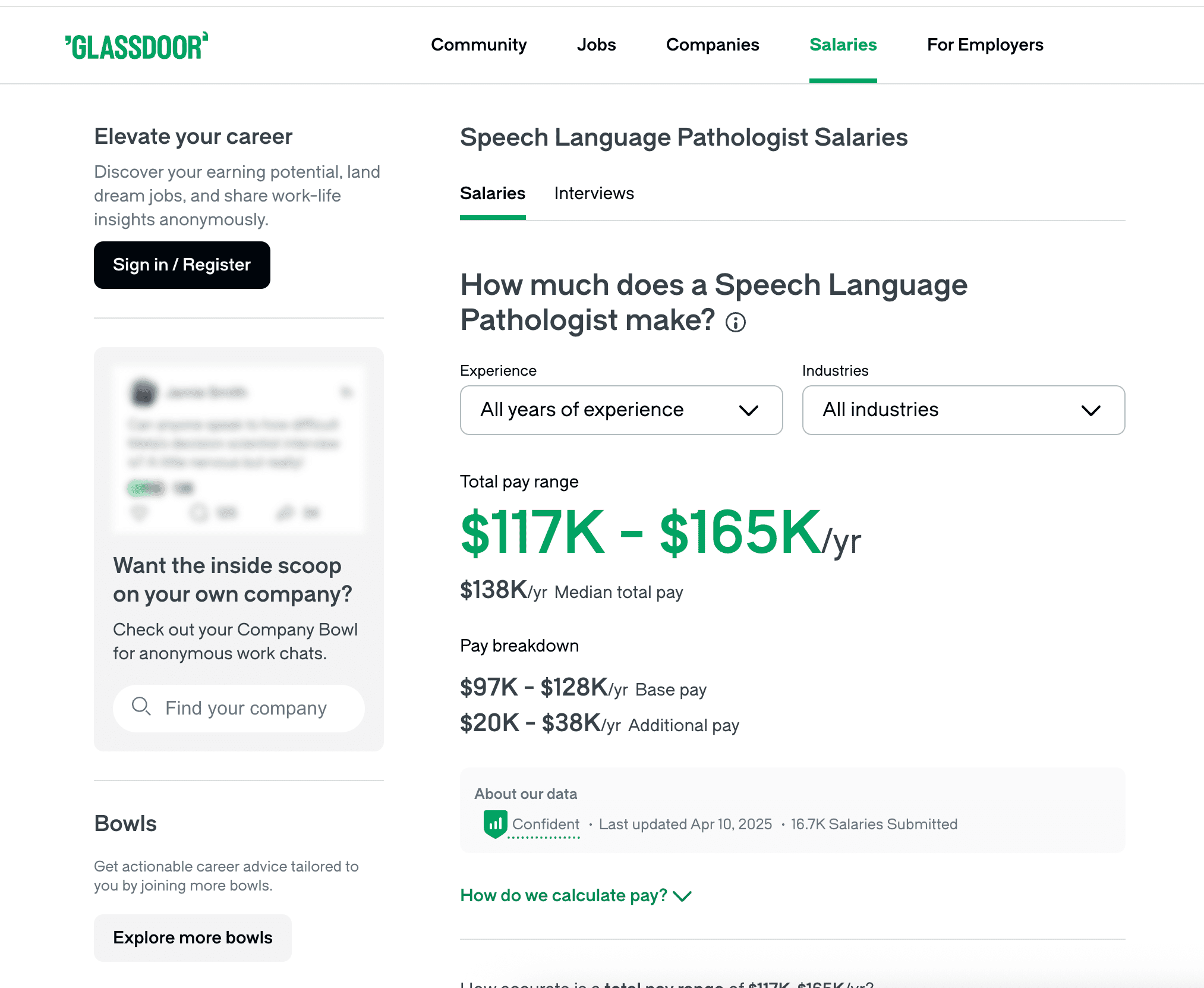
Should we laugh? Should we cry? Either works, but for the grad students or non-SLPs looking at this screenshot, and wondering if it’s real– it’s about $45,000 too high, on both ends. Here are more screenshots.
In sum, you should use the ASHA data as your primary source, alongside our data, and only use the BLS data with extreme caution and a full understanding of in which direction it’ll be inaccurate for your job in particular.
Now let's discuss some myths that really need busted in order for SLPs to be able to advocate for better pay...
MYTH #1: “I can ask other SLPs on Reddit or in a Facebook group about pay…”
Sure. Asking fellow SLPs is a great idea but only if you know what to ask! When asking about SLP pay online, the three MOST IMPORTANT details to clarify are:
- Location
- 1099 vs. W2
- Annual pay (not hourly). Then assume all part-time work will pay better per hour than full-time.
Why ask annual rates, not hourly? Because hourly rates are easily misunderstood and can lead to errors of $10,000–$50,000 when comparing jobs. For example:
- "$50/hour" can = $60,000/year for full-time work
- How? That's what you'd be paid if you're direct time only, with unpaid drive time between clients and unpaid cancellations.
- "$50/hour" can also = $104,000/year for full-time work
- How? Because in this job, the SLP is paid for direct and indirect time with guaranteed hours.
See how it's the same hourly rate, both full-time work expectation, completely different pay? Always talk about contract details and annual pay!
MYTH #2: “I can look at pay averages from a variety of online sources, including the Bureau of Labor Statistics data (BLS), Indeed, Salary.com, ChatGPT, Claude, or Google to predict or negotiate pay.”
OMG did you read anything we wrote above?! Gently teasing here, but no. As we said above, the BLS data and Indeed's data are incredibly misleading and inaccurate for SLPs in particular, due to how they're calculated. And these sources feed everything else.
***Why do you think we're asking SLPs about their pay, when we also operate our own jobs board? Because we have job post wage data! Lots of it. But that can't be used alone to get accurate wage norms.
Want better pay data for our field?
We want that, too! Help by sharing your wage data here.
Note: Because you're sharing your wage data freely, we'll NEVER put it behind a paywall. You can always see and download all the de-identified data, for your own use and analyses.