How to get more applicants to your SLP jobs
What the data says about attracting SLP applicants: pay transparency, job post tips, and recruiting strategies that work.
At Informed Jobs, we want to make it as easy as possible for you to be successful in hiring your next SLP.
This starts with high-transparency job posts, that SLPs know have been quality-vetted, to ensure pay is above the 10th percentile and productivity isn’t higher than 85% (or caseload/workload caps that would support this).
While our process ensures you include the details SLPs want most, here are the most common missteps we still see employers make, as well as some added tips to really make your job post stand out!
Before your job is published:
1. Publish pay as a range, not just starting salary
One of the most common mistakes we see is employers publishing the starting salary only (e.g. $55,000), entirely excluding anyone who’d be eligible for more, or roughly 80% of their candidate pool. We don’t need to explain why excluding 80% or more of candidates will make it hard for you to hire! There are two reasons this happens, even if you specify that it’s the starting salary:
- SLPs filter your job out of their search, or
- SLPs assume you won’t (or don’t want to) pay much higher than your starting salary
Don’t be afraid to publish the true range! Our “Pay Rate Determiners” section will help you set expectations for who qualifies for what (e.g. so a CF doesn’t ask you for the middle of the range).
2. Don’t leave too many items “Undisclosed”
Anything you leave blank on our job posts, the system will insert the text “Undisclosed”. This is fine if one or two items are blank. But it starts to look evasive or suspicious when multiple items are undisclosed.
3. Write a description that’s not repetitive
Our job posts are highly structured. Any details that are in the job post itself, don’t need to be in the description. Instead, use the description to provide new information and explain what makes your company different or great.
4. Add video
If your company already has a professional promotional video, great! However, even a casually-recorded video introducing yourself as the employer, and showing SLPs where they’ll work makes a huge difference. SLPs want to see and feel what it’d look like to work for you. Here are tips and examples.
5. Don't create a dead-end with your Apply link
We can send you all the leads in the world, but if your apply link stinks, this is what will happen:
- You: "I haven't had any applications yet...."
- Us: "Our system shows 200 SLPs have read your job post, and 18 clicked out to apply."
- You: "But I don't have any completed applications or contact information."
- Us: "Ah! Read this."
Some employers want us to just sell them SLPs' contact information. But we don't do that. SLPs use our database specifically because it's based on consent, not violations of their trust. So please let us show you how to get their contact information by making it as easy as possible on them!
After your job is published:
1. Have current staff submit comments
A job post without comments looks like this:

To fix this, simply ask current or former SLPs to comment on your active job post. The SLP field is close-knit, and job seekers rely on peer feedback when evaluating employers. So when real SLPs explain why they enjoy working for you, it makes a big difference! Alternatively, if you already have staff reviews elsewhere online, submit the link in the comment section and we'll link to them.
2. Share your job post on social media
Instead of this:
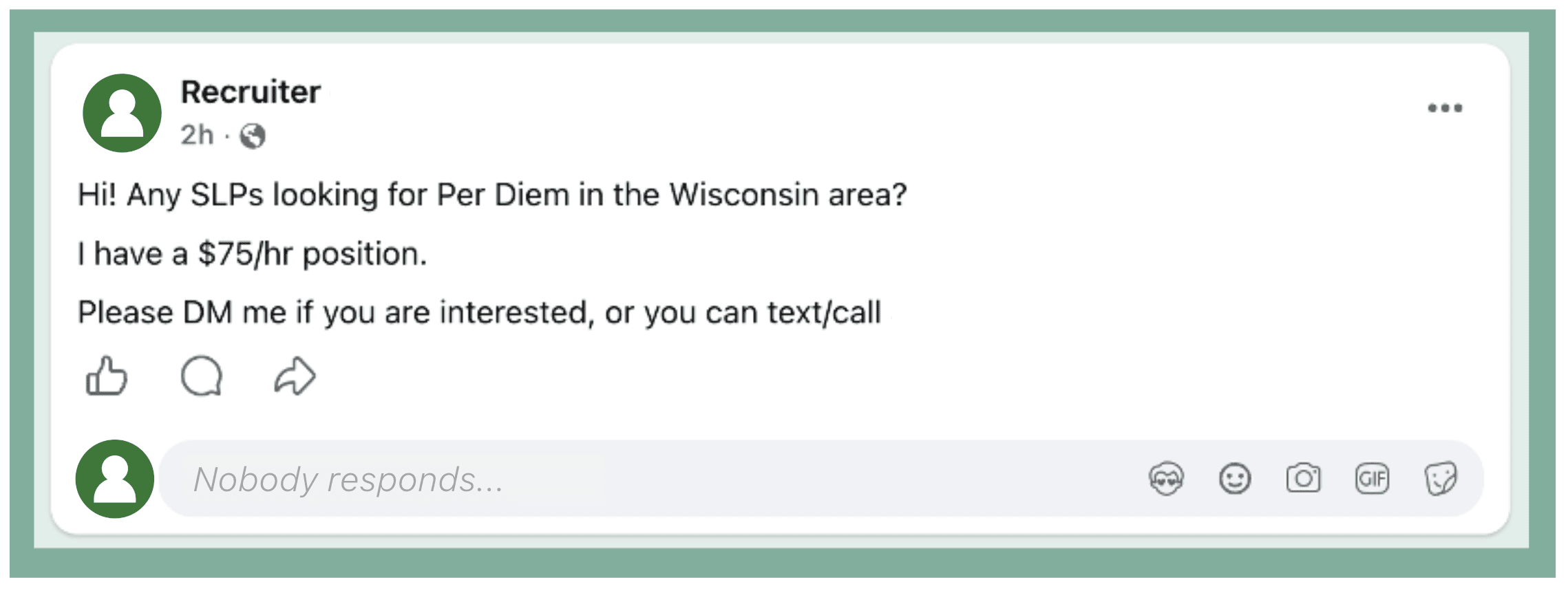
... post the detailed job post you've created with us! Take that link, and share it in as many places as you can—Facebook, LinkedIn, and any local SLP groups. Every bit of traffic helps, and our site links don’t tend to get pushed down in the algorithm as much as e.g. Indeed.
3. Request site traffic as-needed
We'll send you a traffic report every 30 days. It'll show you:
- Whether your job is performing typically
- If people are clicking Apply but not completing applications (we can help you fix this!)
- Whether it's worth pinning your job to the top of the feed as "Featured"
We're working on an Employer Dashboard to show this to you live, which will be available by 2027.
Unlike Indeed or LinkedIn, our staff are SLPs with hiring expertise. Want feedback on how to get more traffic to your post? Just email jobs@theinformedslp.com—we're happy to help!
When it feels like nothing is working
Some employers hiring in speech deserts will have a lot of difficulty getting applicants even when they do everything right, and have an excellent offer. Here are some more options. Don’t get discouraged when you hear someone post online that it’s “easy” for them to hire SLPs, because even they may not realize they simply live in an easy hiring location.
Here’s where to go next, when it’s time to pull out “all the stops”:
1. Consider data on what moves the needle, and adjust if you can
We’re not the type to hoard information. We genuinely want to help you, and will share any data with you that we possibly can! Here is our 2025–2026 report on what moves the needle in SLP job posts.
You’ll notice that the things that may help most aren’t easy to change—the top two are pay and hybrid/remote work. However, you may have to consider those two things if you still can’t hire.
Even something as simple as allowing some telepractice, and allowing report-writing and paperwork to be completed at home, could shift your job from “in person” to hybrid enough that you can advertise it as such. It can make a big difference to SLPs if they only have to come into the clinic 3–4 days per week instead of five.
2. Consider adding outbound or inbound channels
Informed Jobs is an inbound source. That means you’re putting information out there, and waiting for people to come to you. Sometimes that’s enough; sometimes it’s not. Other inbound things you can do include:
- Maximize search and add more inbound. Making sure any internet search will capture your listing. We’re already indexed on Google jobs for you, but you could add LinkedIn or Indeed.
- Add social media. Employers who have active social media accounts often hire from their own social feed. It's a long-game (not a quick fix) but earns you a ton of traffic in the long term, both from SLPs and clients.
- Make sure your website represents you well. If we tell SLPs about your job then they click out to your website and it's pretty "meh", it doesn't make them want to work there. A good website is a good first impression.
- Check that your Glassdoor or Google reviews are in good shape. SLPs like to see that both employees and clients/patients are happy with your company.
- Add employee referral programs. Like we said before, SLPs listen to fellow SLPs! They're your best referral source.
In really tough areas and settings, you may have to also add outbound efforts.
- Networking with SLPs in general makes the most sense for small and medium-sized companies. While networking is time-consuming, employers with stronger social networks of SLPs hire much faster. This includes connecting with other SLPs via:
- Your state association. State associations have groups of SLPs getting together all the time—for planning, volunteering, conferences, and networking. It’s how lots of SLPs meet fellow SLPs in their area!
- Local Universities. Employers whose SLPs supervise students have a stronger pipeline. Even just a couple students per year means a couple referrals for an entire cohort of SLPs.
- Any local SLP groups you can find. Every city is different, but many have regular SLP get-togethers. And if your city doesn’t, consider being the host! SLPs love networking with each other, and something as simple as a standing monthly coffee shop rotation really builds those connections.
All these activities mean a network of people you can reach out to when you're hiring, and they can reach out to people they know on your behalf.
- Large companies have much more aggressive inbound and outbound efforts, which include things like: running ads, exhibiting at conferences, and buying lists of SLPs’ contact information and hiring recruiters to call, text, and email SLPs. These types of activities run in the tens of thousands of dollars (or more) but it’s how the largest companies are ensuring their pipeline.
3. If you’ve checked all the boxes...
If you've done every single thing on this list and are STILL having troubles hiring, sometimes you just have to keep at it . The SLP market is tough, but set small goals for each week of things you can do to expand the number of SLPs you can connect with, and the right candidate will come.
Additionally, it can help to consult and connect with people who are in the same boat. There are lots of SLP Facebook groups for employers, and even podcasts for people who employ SLPs. Hearing that what you're going through is normal can really help! We're also here to support, so reach out anytime.