The SLP burnout problem, Part 1: The definition contains the solution
Understanding what burnout is, and isn't, is the first step.
Burnout is a hot topic in basically every profession right now, and may be on the rise (more on that later). Data suggests that certain aspects of a job, both in terms of the career and the specific organization, can make it more likely for people to report burnout (more on that later, too). But we can’t talk about burnout at all, and especially not solutions to burnout, without getting on the same page with a definition.
And here's the problem: employers and employees aren’t talking about the same thing with the word “burnout,” and that affects how, where, and for whom solutions happen. So we’ll help you correct that within your organization.
Burnout is about the work, not the worker.
The WHO ICD-11 defines burnout as an occupational problem, not an individual one, characterized by three dimensions:
- Energy depletion or exhaustion,
- Mental distance or cynicism toward one's job, and
- Reduced professional efficacy
… within the occupational context and not relating to other areas of life. Or, “burnout results from chronic workplace stress that has not been successfully managed."
While the WHO/ICD-11 definition draws a line between burnout and, e.g., depression, it says nothing about who controls the stressors that cause burnout in the first place, nor where responsibility sits. But that’s always the next step, isn't it?
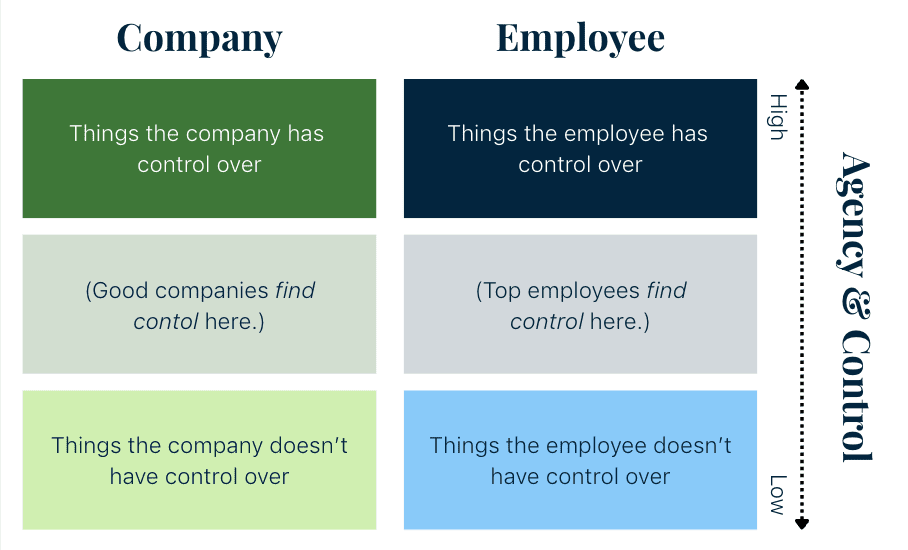
If you ask folks in your life or on TikTok or Instagram, they may say burnout is caused by toxic workplaces. They may say burnout is caused by employees' mindset. They may say burnout is caused by anything, within any of these categories (below), sensical and nonsensical, spanning the range from within to outside both employers and employees’ control:
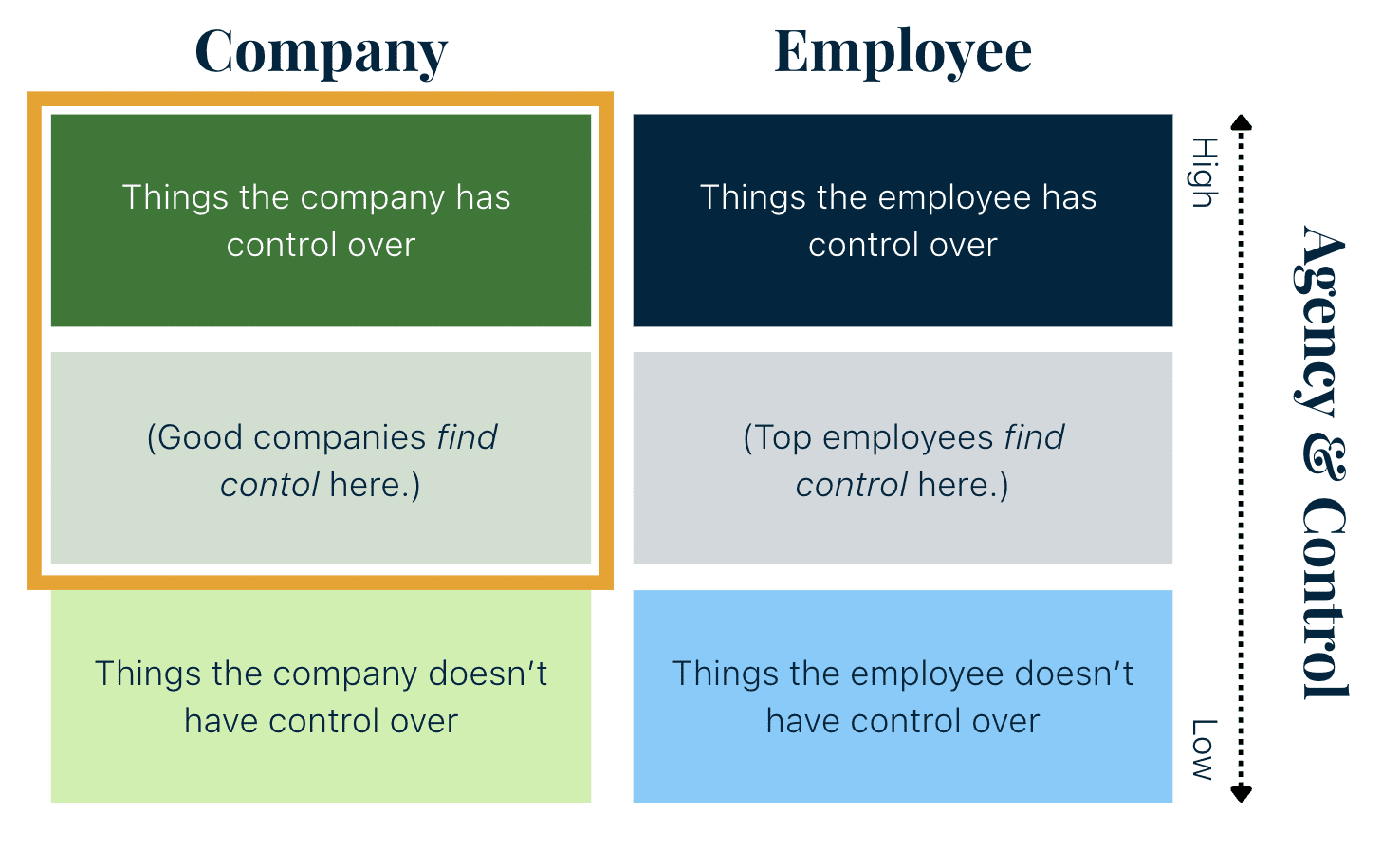
But if you ask burnout researchers, they’ll (usually) suggest the focus should be on things the company can control or could reasonably control:
Your definition of burnout will determine your solutions—and whether they work.
Have you ever heard the phrase “a problem well-stated is a problem half-solved”? Or maybe “the definition contains the solution” (we don’t know who said that… somebody smart).
Your definition can make the problem of burnout a manager’s problem, an individual’s problem, or a mental health professional’s problem. Or, if you zoom all the way out and assume it's cultural or systemic, you’ll wait for the government or perhaps our entire society to fix it.
When your definition of burnout clearly specifies the problem as workplace-specific, it directs focus to the workplace rather than the individual for solutions. On the flip side, poor or too-broad definitions can inappropriately shift responsibility and action. Here’s how that could look:
- If you think the organization causes burnout, you’ll put organizational changes in place. Specifically:
- If you think it’s within the org’s control, you’ll try things like adjusting workload, increasing opportunities for autonomy, paying for all hours worked, and considering employee feedback to make organizational changes. (If you guessed that this is where the research suggests you start—ding ding ding!)
And if you think it’s outside the org’s control, you’ll try things like: idk, nothing?
- If you think something about individual employees is causing burnout, you’ll put individual-worker solutions in place. Specifically:
- If you think it’s within employees’ control, you’ll try things like resilience training, mindfulness apps, and self-care. (Which are fine, but organizational changes work better.)
- If you think it’s outside the employee’s control, you’ll try things like eventually firing people who report burnout and training your leadership team to hire “burnout-proof" employees in the first place. (Not recommended.)
In sum, if you think burnout stems from the organization, you’ll put organizational resources behind the most effective ways of fixing it. If you think burnout stems from the individual, it not only shifts that responsibility, but also limits the organization’s legal and ethical ability to get involved. Instead, you end up referring people out to mental health services and/or adding some wellness perks.
Let’s acknowledge the tension here
Some of you may have a tiny voice in the back of your mind saying, “OK, I’m mostly on board with burnout being an organization’s problem to fix. But I know it’s not only, or always, or entirely, the org’s fault when someone is burned out.” And you would be correct! But the reason it’s so important for employers to start with the more expert-agreed-upon definition before expanding with nuance and exceptions is that you’ll miss solutions if you approach it other ways first.
Employers who do lean into the “burnout is just depression with a laptop—and I can’t control depression” definition are at risk of bypassing the stage of taking the necessary organizational responsibility. Same with employers who assume that the widespread existence of burnout means it’s a cultural or systemic problem, with cultural or systemic causes, which therefore the employer cannot fix (a false conclusion). Because the research suggests there is plenty you can do as an employer, it’s best to start there.
We can’t say this enough: Start at the top
Real life is messy and full of complex interacting factors, and burnout is no exception. But we’ll make this argument one last time before proceeding, just for good measure: It’s a bad idea to allow individual factors to be your primary explanation of burnout, because it’s the quickest off-ramp from organizational responsibility. And the research suggests starting with the org simply works better. Here’s the bottom line:
For employers:
- Burnout is an organizational problem to solve. Period.
- You can't prevent all of it. That's fine—do what you can.
Mental health issues can absolutely surface at work, but that's not burnout. That’s separate territory employers mostly can't and shouldn't touch. Refer out, and loop in an HR attorney if you're unsure what to do.
For individuals:
- Employers should be preventing burnout wherever they can.
- At the same time, you only control you. Give your boss feedback and make reasonable requests. Persistent issues here are a common reason people leave jobs.
- If burnout is spilling into other areas of your life, see a mental health professional to help you tease apart work-related burnout from other challenges you might be dealing with. Autistic burnout is worth a mention here, but not the topic of this article as it’s different and requires different solutions.
In Part 2, we’ll point you toward specific levers employers can press to make workplaces more burnout-resistant. If you want to understand burnout better, read on below for the answers to a few more questions we researched along the way!
1. Are SLPs more at risk of burnout than other professionals?
Unknown. Maybe.
There is some SLP-specific research. But we couldn’t find anything that directly compared SLPs to other professions in any way that would allow you to conclude that SLPs are at a higher risk of burnout than any other profession. Here’s what we did find:
- A study that directly compares physician burnout against the general US working population found physicians were ~80% more likely to experience burnout than the general US workforce. They adjusted for enough other factors to conclude that something about the work itself likely heightened risk.
- One prediction is that it’s about the people-facing intensity. And if that's the case (we don’t actually know), then that factor would also apply to SLPs.
- Other studies like this one have found that social service occupations rank higher for burnout than other professions (again with the people-factor). Burnout research in general points to high job demands and lack of control increasing burnout; but working with vulnerable people who have experienced trauma is also a factor, and the argument could be made that SLPs do more of that than the average worker. It’s the whole "emotional labor" thing that applies to nurses, doctors, social workers, teachers—and us.
- However! Caveat time:
- There's more burnout research in people-facing fields because that's where the concept was born.
- The original Maslach Burnout Inventory was built for human services and education — the general-workforce version didn't appear until 1996.
- Some studies find burnout is particularly heavy among corporate workers, too. But different factors may drive it (e.g., lack of autonomy and time pressure).
- Within people-facing fields, variability remains high, and imprecise definitions make sorting it all out even worse.
Overall, people-facing work appears to be a risk amplifier for burnout, not the root cause. Which brings us to the second thing we wondered…
2. Is burnout on the rise?
Another maybe:
- It’s tough to know if it’s on the rise, despite headlines reporting burnout at a record high and on the rise. A lot of this is cherry-picking and lacks context.
- It can feel post-COVID, but there’s no data to support that either. While burnout spiked during COVID, it’s also receded. And I know it’s hard to remember the before times, but recall how burnout was pinned on millennials pre-COVID? (We could say more, but will throw our avocado toast at the wall instead…)
- Variable definitions screw everything up, especially when trying to track historical trends.
- Declining stigma of reporting burnout is a good thing, but also screws up the ability to measure over time.
- There are plenty of employer-side factors that may explain a rise in burnout:
- Work intensification in both speed and deadline pressure
- Meeting and communication load increase
- Companies downsizing, leading to workload absorption
Technology changes, including increased boundary erosion, always-on responsiveness, unstable scheduling, and increased and expanded electronic monitoring (read more here and here).
In sum, we don’t really know for sure that burnout is on the rise, and part of what complicates that is that other things could be exacerbating it. Just keep in mind that there isn’t an “evil villain ruining it all” here. Employers aren’t downsizing for funsies, and employees aren’t stressed at work because they just love being stressed. We’re all living in the same world here, and who knows what’s really going on when it comes to burnout. In that vein, we focus on what we can control.
3. Is it true that burnout’s impact lasts for years, even after you change jobs?
No. Not unless you have a severe clinical case.
This is a good example of the “don’t believe everything you read on social media” lesson. Our team is science communicators, so we’re sticklers about not spreading misinformation. And even we re-learn, over and over again, that—shocker!—much of what’s on Instagram and TikTok is outright wrong, even when research is cited. Social media rewards virality, not accuracy, so remain cautious.
What does the research actually say? You’ll definitely find studies of groups where burnout symptoms persist for years, even after changing jobs. But these studies are only of people with severe cases, who were referred to a specialist stress clinic after months of sick leave. No control group, and no differentiation between burnout using the ICD-10 definition, where it’s occupational-only, as it loops in people burned out from private-life stressors as well. Therefore, this can’t be applied to the broader population of people who experience mild to moderate burnout and just keep working.
4. Do all the experts agree on one definition of burnout?
Well, no. You’ll find the lines between organizational effectiveness, burnout, mental health, and personality blurred all the time, in quite uncomfortable ways. You’ll find scientists who write papers on burnout where the focus is more on individual resilience and grit or personality. You’ll find scientists who don’t think the line(s) should be drawn so firmly, arguing that “the distinction between burnout and depression is fragile.” You’ll find business coaches who, if you report to them the features of burnout in one of your employees (e.g., slow work, declining attitude toward the work), they’ll jump straight to recommending you put the person on a performance improvement plan (PIP) without looking at organizational issues that could be causing burnout first.
And it’s not that these expansions of the burnout definition are wrong, per se. It would be dishonest to say there is no data that individual factors impact burnout, because there is. And some experts argue that leaning too hard into burnout as non-individual can minimize real individual risks and leave true mental health disorders untreated and unsupported.